Brainstorming Session on ‘Traceability, Transparency and Sustainability in Cotton Value Chain’ organized
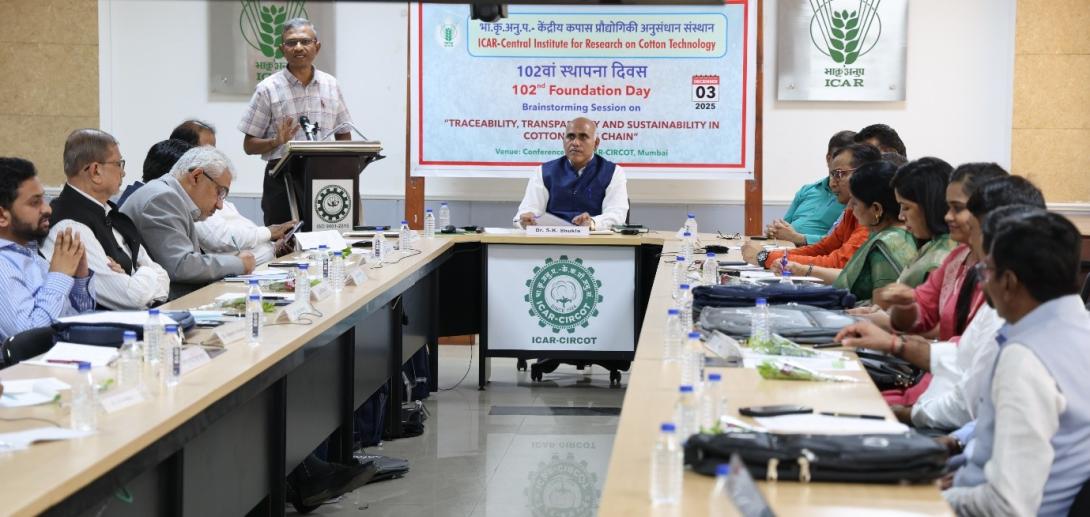
The ICAR-Central Institute for Research on Cotton Technology (CIRCOT), Mumbai, commemorated its 102nd Foundation Day and Agricultural Education Day celebrations on December 3, 2025, by hosting a brainstorming session titled ‘Traceability, Transparency and Sustainability in Cotton Value Chain.’ The event was conducted in a hybrid mode, ensuring broad participation from a diverse group of stakeholders, including key researchers, industry leaders, innovative startups, and progressive farmers.
The session was chaired by Dr. S. K. Shukla, the Director of ICAR-CIRCOT, and convened by Dr. N. Vigneshwaran, Principal Scientist & Head of the CBPD division at ICAR-CIRCOT. Dr. Vigneshwaran opened the discussion by comprehensively outlining the fundamental requirement for embedding both traceability and transparency as necessary components for the sustainable development of the entire cotton value chain. He further elaborated on the various tracing technologies currently available globally, simultaneously detailing the practical challenges Indian industries are facing in adopting these systems. He also provided an explanation regarding the current status of a physical tracer technology being actively developed within the Institute itself.

During his opening remarks, Dr. Shukla elaborated on the inherent problems encountered in the sole adoption of digital traceability solutions. He strongly emphasized the critical necessity for developing and using physical tracers to provide concrete evidence that supports claims of sustainability, which is essential for maintaining brand values and consumer trust. He mentioned that the global buyers demand verifiable proof of ethical sourcing and sustainable practices, which is difficult to provide due to India's fragmented supply chain. He suggested that traceability provides an immutable digital record of the cotton's journey from farm to market, allowing exporters to concretely demonstrate compliance with social and environmental standards.
Besides external stakeholders, the internal participants included Heads of Divisions, Scientists, and Technical Officers from ICAR-CIRCOT, Mumbai. All participating stakeholders contributed significantly by sharing their practical, real-world experiences. The brainstorming session concluded with a well-defined set of actionable recommendations aimed at long-term sectoral improvement. The key recommendations included the development of an indigenous, customized traceability solution for the cotton value chain, including technologies such as physical and DNA tracers alongside digital tracing. Additionally, the development of these systems must be farmer- or region-centric, aligning with the specific requirements of end-users or brands. Successful implementation requires collaborative work among all stakeholders for the technology's rapid development and widespread adoption.
- पिछले पृष्ठ पर जाने के लिए
- |
-
पृष्ठ अंतिम अद्यतन तिथि:04-12-2025 02:36 PM
Footer Logos